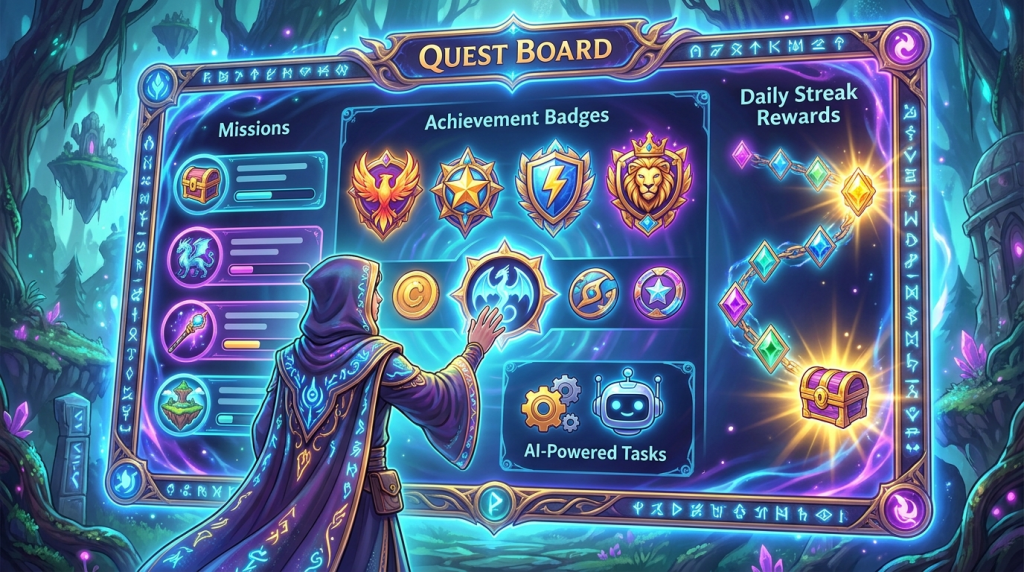

For most of 2025, OpenLedger was one of the busiest testnets in crypto. People ran browser-extension nodes for heartbeat points, answered Datanet tasks for Epoch 2 scores and climbed Kaito leaderboards, all hoping for an allocation. That phase is over. The OPEN token went live in September 2025, the testnet points were converted into token allocations, and anyone still searching for an “OpenLedger points campaign” should understand that the rules have changed. Rewards now come from contributing to a live AI network, not from building up a testnet score. This guide covers what OpenLedger is, how the testnet points worked and turned into OPEN, what earns rewards now, and how to avoid the fake claim pages that still target this project.
What OpenLedger is
OpenLedger calls itself an AI blockchain. The idea is that the data and fine-tuning behind specialised AI models should be tracked on-chain, so that people who supply data are paid when the resulting models are used. Its documentation describes several building blocks:
- Datanets: community-owned datasets on a specific subject. Anyone can create a Datanet or contribute to one, and each contribution is verified and recorded on-chain.
- ModelFactory: a no-code interface for fine-tuning models on Datanet data.
- OpenLoRA: a serving system that runs many fine-tuned LoRA adapters on a single GPU, which lowers the cost of hosting niche models.
- Proof of Attribution: the mechanism that traces each model output, whether from a chat, task or API call, back to the model and the training data behind it, and splits rewards among contributors.
The chain itself is an Ethereum Layer 2. It uses EigenDA for data availability and settles to Ethereum, and OPEN is both its gas token and the token used for attribution rewards. Governance runs on an OpenZeppelin Governor setup, where OPEN holders vote on model funding, agent rules, upgrades and the treasury.
How the testnet points worked
The incentivised testnet, launched with a CoinList announcement in early 2025, had two main ways to earn points.
Nodes and heartbeats
Users installed an OpenLedger node as a Chrome extension or on Android, iOS, Windows, macOS or Linux. Each eligible node earned a heartbeat credit every five minutes. The rules capped each account at three active nodes, in combinations of two mobile devices plus one extension or three mobile devices. Running more than one browser extension at once disabled heartbeat rewards entirely. Referral earnings and event bonuses were added on top, and streak bonuses rewarded consecutive days of uptime.
Epoch 2 and Datanet tasks
Epoch 2 started in March 2025 and shifted the focus from bandwidth to knowledge. Users applied to join Datanets, had to pass an assessment before tasks unlocked, and then completed validation, categorisation or analysis work. Points depended on difficulty (30 for hard, 15 for medium, 10 for easy tasks) and were scaled by accuracy. Answers above 70% accuracy earned full points, while those below 30% earned nothing. Reviewers validated answers before points were credited, and each Datanet had its own leaderboard.
This design rewarded quality over volume, which matters for anyone hoping for a similar program in the future. OpenLedger has shown it will score work by accuracy, not by the number of clicks.
The OPEN launch and where the tokens went
OPEN launched in September 2025. Binance listed it on September 8 as the 36th project in its HODLer Airdrops program. Ten million OPEN, 1% of the maximum supply, went to users who had BNB in Simple Earn or On-Chain Yields during a window in mid-August. Other exchanges listed the token around the same time, and a separate Binance Alpha event gave OPEN to users above an Alpha points threshold.
Key supply figures published at listing:
- Maximum supply: 1,000,000,000 OPEN.
- Circulating at listing: 215.5 million OPEN, or 21.55%.
- Team and investor tokens: a 12-month cliff followed by linear release, according to exchange research summaries, with community and ecosystem tokens released over a longer schedule.
Testnet contributors received allocations through an eligibility and claim process run by OpenLedger. Third-party guides described two claim options: a standard claim to the wallet, or a claim-and-stake route. Treat those guides as secondary sources, since the official announcements are the reference. OpenLedger also ran a creator program on Kaito, which ranked content creators and paid OPEN to the top of the leaderboard over several months.
A month after launch, the OpenLedger Foundation announced an OPEN buyback program funded by enterprise revenue. Some exchange explainers also mentioned a second HODLer distribution tranche about six months after listing. We could not confirm that schedule in OpenLedger’s or Binance’s own announcements, so do not plan around it.
Is there still an OpenLedger points campaign?
Not in the old sense. At the time of writing, OpenLedger has not announced a new points season or a second airdrop for testnet-style activity. The heartbeat counter and Epoch leaderboards belonged to the pre-token phase.
What exists instead is the design the testnet was building toward:
- Data contribution rewards. Contributors to Datanets are rewarded through Proof of Attribution when models trained on their data are used. Payment depends on actual model use, not on a fixed score.
- Model builders. Developers who fine-tune and publish models through ModelFactory can earn from inference usage.
- Staking and governance. OPEN holders can stake through the portal linked from the official site and vote on proposals. The documentation describes staking rewards as tied to participation in designated programs, not to validating the network.
- Ecosystem activity. OpenLedger has been signing integrations, including a January partnership with Theoriq on verifiable AI agents in DeFi and a collaboration with Story Protocol on rights-cleared training data that pays creators automatically. Partner campaigns like these sometimes carry their own incentives, which are set by the partner.
Rewards are now more closely tied to real usage and are much harder to farm with idle browser tabs.
How to take part today
- Start from openledger.xyz. Use the links on the official site to reach the studio, Datanets, explorer, staking and docs.
- Read the Datanet requirements. Many Datanets require an application and an assessment. Choose subjects you actually know, since accuracy is what gets rewarded.
- Contribute carefully. Low-quality or copied submissions are filtered out and can count against you. One good dataset entry is worth more than dozens of rushed ones.
- If you hold OPEN, decide whether to bridge it to the OpenLedger L2 for gas, staking and governance, or to leave it on Ethereum or an exchange. Use only the official bridge listed in the docs.
- Follow governance. Proposals on model funding and treasury use show where future incentives are likely to go.
- Keep records of contributions, staking transactions and any claims. They matter for tax and for resolving support tickets.
Risks specific to OpenLedger
- Token unlocks. Only about a fifth of supply circulated at launch. Team and investor cliffs ending in the second half of 2026 and ongoing community releases will add sell pressure. Check the unlock schedule before buying or staking.
- Price volatility. OPEN rose sharply on its Binance debut and fell heavily afterwards. Rewards paid in OPEN can lose much of their value between earning and selling.
- Attribution is new technology. Measuring which data influenced a model output is an active research problem. Reward splits may change as the method evolves, and the docs mark several sections as subject to change.
- Demand risk. Attribution rewards are only as large as the paid usage of models. If enterprise and developer demand stays small, contributor income stays small.
- Bridge and L2 risk. Moving OPEN between Ethereum and the L2 depends on bridge contracts and on the rollup’s sequencing and settlement.
- Data rights. Upload only data you have the right to share. Proof of Attribution records who contributed what, permanently.
Spotting fake OpenLedger claim pages
- Official channels: the website is openledger.xyz, the documentation is at openledger.gitbook.io/openledger, and the X account is @OpenledgerHQ. Reach the staking and claim pages through links on these, not through search ads.
- “Epoch 3 airdrop” or “second OPEN drop” pages that ask you to connect a wallet are not supported by any official announcement. Unless the X account and docs mention a new distribution, treat it as fake.
- Node-download scams. Because the testnet ran on extensions and mobile apps, a “new OpenLedger node” download is an easy lure for malware. Install software only from links in the docs or the official store listing they point to, and remove old testnet extensions you no longer use.
- Approval requests. Checking an allocation never requires approving token spending. A request to approve OPEN, USDT or ETH on a “claim” page is a drainer.
- Impersonated support. The Discord team will not DM you first. Nobody legitimate needs your seed phrase or the Gmail account you used for the testnet login.
FAQ
Can I still earn testnet points?
No. Heartbeat points and Epoch leaderboards were part of the pre-launch testnet. Rewards now come through Datanet contribution, model usage and staking programs.
I ran a node but never claimed. What now?
Check the official channels for the claim portal and any deadline. Third-party guides warned that missing the deadline forfeits allocations. Never use a claim link sent to you by someone else.
Is OPEN an Ethereum token?
OPEN is the native gas token of OpenLedger’s L2 and can be bridged to Ethereum through the official OpenLedger bridge. Check contract addresses in the docs before buying it on a DEX.
Will there be another OpenLedger airdrop?
Nothing has been announced. Community and ecosystem tokens are released over several years, so future incentive programs are possible, but nobody can tell you today who will qualify.
Verdict
OpenLedger’s points era ended with a large, widely distributed launch, and the project is now trying to prove that data attribution can pay contributors from real model use. That is a slower and less predictable way to earn than a heartbeat counter, but it is the version of OpenLedger that matters now. If you have relevant expertise, contributing to a Datanet is a reasonable way to take part. If you are only looking for the next free allocation, there is no announced program to farm, and any page claiming otherwise should be treated as a scam until @OpenledgerHQ confirms it.
This article is for information only and is not financial advice. Tokens and staking programs carry the risk of loss.
Related guides
- Gensyn Testnet 2026: How to Use the Dashboard and Track Node Activity Safely
- Allora Network Rewards 2026: After the ALLO Airdrop, How Workers, Forge, and Reputation Earn
- Knidos Testnet Goes Live: How to Earn AP and Position Yourself for a Potential Future Airdrop
- 0G Galileo Testnet 2026: How to Use the Portal, Faucet, and Explorer Safely